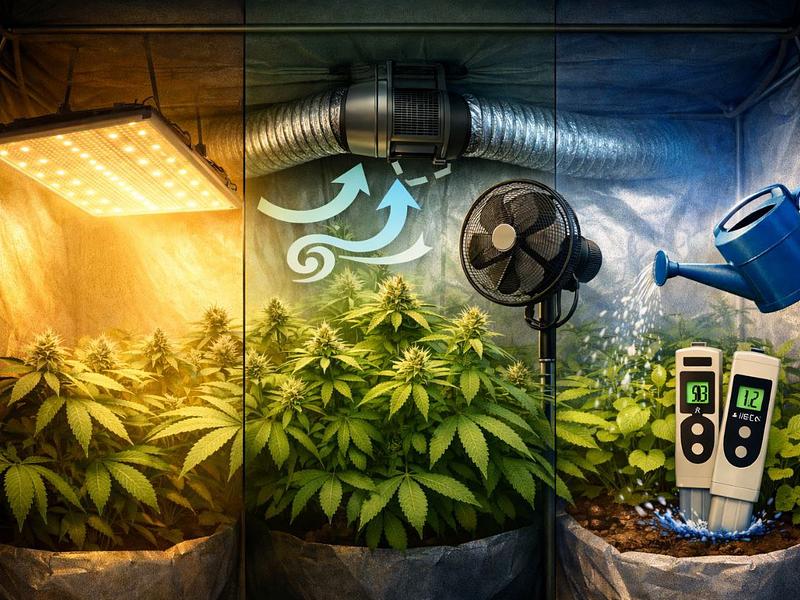
Light, Air, Water: The 3 Pillars of Successful Indoor Cannabis Growing
Indoor growing offers the cultivator complete control. But this also means taking full responsibility for creating the ideal conditions that nature usually provides on its own. Beginners often obsess over soils, nutrients, and exotic techniques, overlooking the very foundation. The real secret to healthy growth and bountiful harvests at home lies in the unwavering balance of three fundamental pillars: Light, Air, and Water. If you master these three elements, you will solve 90% of potential problems. Let's break down each "pillar" in detail. Pillar 1: Light – The Primary Engine of Photosynthesis Indoors, the sun doesn't shine – its role is played by your lighting. This isn't just a bulb; it's a substitute for solar energy, directly determining the size, density, and quality of your buds. What You Need to Know: Type: Today, LED grow lights are the gold standard. They are energy-efficient, emit little heat, and allow for precise spectrum tuning (blue for veg, red for flower). Intensity (PPFD): This is the key parameter – how much usable light energy reaches the plant. Too little intensity = stretched, weak seedlings. Too much = light stress and burns. Use smartphone apps (like Photone) for a rough estimate. Photoperiod (Light Cycle): 18 hours of light / 6 hours of darkness for the vegetative stage and 12/12 to initiate and maintain flowering in photoperiod strains. The Golden Rule: Don't skimp on light. A quality LED grow light is the best investment in your harvest. Hang it at the correct height (according to manufacturer guidelines and plant response). Pillar 2: Air – The Invisible Life Support System Many underestimate the role of air, yet it is the circulatory system of your grow space. Without proper circulation and gas exchange, all other efforts are in vain. Two Key Components: Exhaust Ventilation: This is the "heart" of the system. An exhaust fan with a carbon filter removes hot, stale air, creating a slight vacuum. This prevents stagnation, controls temperature/humidity, and ensures an influx of fresh, CO₂-rich air. Internal Circulation: Ordinary household or oscillating fans create a gentle breeze through the plant canopy. This strengthens stems, disrupts the stagnant microclimate around leaves (preventing mold and mildew), and ensures even distribution of heat and humidity. The Golden Rule: Your exhaust fan should be powerful enough to completely replace the air in your grow space every 1-3 minutes. The breeze from internal fans should be felt but not strong enough to bend stems. Pillar 3: Water – The Basis of Life and Main Transport System Water is not just a liquid for irrigation. It's the transport system delivering nutrients to cells and the plant's internal temperature regulator. What You Need to Control: Water Quality: Soft water with low mineral content is ideal. Start by measuring EC/TDS (total dissolved solids) and pH. This is critically important. Medium pH: Roots can absorb nutrients only within a specific pH range. For soil, this is 6.0-6.8, for hydroponics/coco – 5.5-6.2. Watering with the wrong pH leads to nutrient lockout, even if fertilizers are applied correctly. Watering Schedule: Water based on the plant's needs, not a fixed calendar schedule. Overwatering is a common cause of root rot. Underwatering causes stress and wilting. Allow the top layer of soil to dry out slightly and the pot to feel lighter before the next watering. The Golden Rule: "Water when needed, not when convenient." Invest in an affordable pH meter and EC/TDS meter. These are your most important diagnostic tools. How the Three Pillars Work Together: An Example of Imbalance Imagine: You bought a powerful light (Pillar 1), but a weak exhaust (Pillar 2) can't remove the heat. The temperature in the grow space soars to 35°C (95°F). The plant starts transpiring heavily through its leaves to cool down (Pillar 3). The roots can't supply water fast enough, causing water stress and disrupting nutrient uptake. The result: light burns, wilting, stunted growth. Is the problem the light? No. The root cause is the air. ConclusionIndoor cultivation is the art of creating a stable, balanced environment. Don't rush to buy the latest gadgets before you've mastered the basics. First, provide your plants with: Powerful, high-quality light on the correct schedule. Strong exhaust ventilation and canopy air circulation for fresh air and sturdy stems. Watering with quality water at the correct pH only when the plant truly needs it. When these three pillars stand firm, you will see how resilient, healthy, and generous your plant can be. Everything else is just fine-tuning an already well-oiled machine.