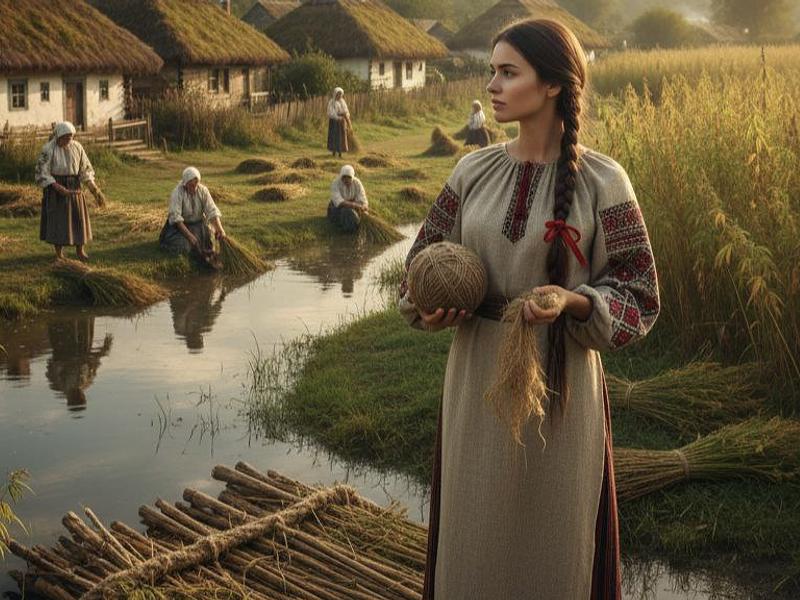
Hemp Shirt and Embroidery: How the Plant Wove the Fabric of Ukrainian Life
The Forgotten Threads of Our History Today, when we talk about cannabis, the imagination often conjures modern clubs, medical applications, or legalization debates. But for our great-grandparents, this plant was something far more mundane and vitally essential – the cornerstone of the household, a synonym for prosperity, and practically the "green gold" of the Ukrainian home. Hemp, or "poskon," as it was often called, was an inseparable part of the cultural code and daily life. It provided clothing, food, fuel, paper, ropes, and even ritual symbolism. This article is a journey into the past, exploring how the hemp thread wove the very fabric of Ukrainian existence. "Poskon" in the Field: From Seed to Stalk The cultivation of hemp (Cannabis sativa L.) on Ukrainian lands has a millennia-old history, confirmed by archaeological findings of seeds. This crop was very demanding of soil fertility, so it was often planted in kitchen gardens and carefully fertilized. There was even a specific distinction: Poskon — male plants. Taller, thinner, they matured earlier and produced finer, more elastic, and durable fiber for fabrics. Materka — female plants. Their fiber was coarser but stronger, ideal for ropes, cords, and twine. The harvest was a whole ritual. Male plants were gathered in early August, and female plants in September, after seed ripening. Stalks were not cut but pulled up by the roots to preserve the fiber length. The Secret Soak: From "Retting" to "Scutching" After harvesting began the long and labor-intensive processing, passed down through generations. Retting (dew or water retting). This is the most crucial stage. Bundled stalks were soaked in water bodies – ponds or special "retting pits." Under the action of water and bacteria, the pectic substances binding the fiber to the woody core decomposed. This process could last from a few days to two weeks and required great expertise – over-retting meant weak fiber. Drying. After retting, the bundles were laid out in meadows to dry in the sun. Breaking and Scutching. The dried stalks were broken on special brakes or against a log, then beaten with wooden scutching knives to separate the hurds (woody part) from the valuable bast fiber. Hackling. The cleaned bast was combed on metal "hackles," resulting in a fine, silky, ready-to-spin fiber – tow. Coarser waste ("codilla") was used for rope making. Tow, Loom, and the "Hemp Shirt" Spinning was exclusively women's work, done in winter, often collectively – at "vechernytsi" (evening gatherings). Tow was spun on a distaff or spinning wheel, creating a fine, strong thread. The loom (krosna) became the main tool for transforming threads into cloth. Woolen, linen, and hemp fabrics were woven. Hemp cloth was the strongest and most practical: Coarse cloth went into sacks ("sirukhy"), sheets, bedding, undergarments, and work clothes. Finer cloth, often mixed with flax, was used for shirts (embroidered shirts/vyshyvankas), tablecloths, and towels. It is important to understand that a hemp shirt was not white and soft like modern cotton. It was the color of the natural fiber – from grey to beige, very strong, somewhat coarse, but incredibly durable. It could be worn for decades. Whiteness and softness were achieved by repeated boiling in lye and beetling. The Silk of Poskon and Military Ropes Hemp fiber has unique properties that made it indispensable: Hygroscopicity and Strength. It withstood moisture better than flax, didn't rot, making it ideal for fishing nets, seines, and ropes in river and maritime transport. Tensile Strength. Fiber from the "materka" was used to weave the strongest ropes, tethers, harnesses, traces for livestock, and smoke ropes (for thatching) for securing straw on roofs. Durability. Hemp sacks (sirukhy) for grain withstood heavy loads and were not damaged by pests. The refined fiber of poskon was especially highly valued. It quickly displaced other technical crops like nettle for spinning in Ukraine. Fine, modern-like fabrics for undergarments and light summer clothing were woven from it. Rituals, Symbolism, and Prohibitions Hemp was deeply woven not only into daily life but also into ritual life and folklore. Rituals: Girls going to their first dance might put a hemp flower in their shoe so that boys would "take notice." During caroling, there were special "hemp" shchedrivky (songs) wishing for a rich harvest. Folk Wisdom: "The grandfathers sowed hemp, and the grandchildren are tending it" (about negligence). "Hemp in the field – prosperity in the house." Economic Backbone: In the 19th century, Ukraine was one of the main European exporters of hemp yarn and cloth. The railways and navy of the British Empire required thousands of tons of hemp ropes, some of which were produced in Ukrainian lands. Decline: The 20th century brought prohibitions linked to international narcotics conventions, along with the advent of cheap synthetic and cotton fibers. The industrial hemp farming that remained in the USSR was oriented solely toward technical needs and lost its connection to folk culture. Conclusion: Reviving Memory Today, on the wave of interest in ecology and natural materials, hemp is returning as a raw material for textiles, paper, and building materials. But beyond its economic potential, it is important to remember its cultural and historical roots. The hemp thatch on the roof, the sturdy sack on the shoulder, the coarse but incredibly durable shirt – these were not just household items. They were the result of year-round labor, deep knowledge of nature, and skills passed down through generations. By exploring the history of hemp in Ukraine, we are restoring a piece of our lost identity, where this plant was not a symbol of something marginal, but a synonym for hard work, prosperity, and an unbreakable connection to the land. This is the true thread of our history, worth remembering.